Idempotency is one of the most crucial concepts that are used in programming and system engineering to enhance efficiency and dependability. An operation is said to be idempotent when its application of more than one does not affect the outcome of the first application. This property is important in many situations, especially in distributed systems, web services and APIs where the same operation might have to be done repeatedly because of the networks, retries or actions from the user’s end.
What is Idempotency?
In simple terms, an idempotent operation produces the same outcome whether it is executed once or multiple times. For example, setting a variable to a specific value is an idempotent operation because no matter how many times you assign that value, the result remains unchanged.
Examples of Idempotent Operations
1. HTTP Methods:
- GET: Fetching a resource from a server is idempotent because it does not change the resource state.
- PUT: Updating a resource with the same data repeatedly does not change the outcome after the first application.
- DELETE: Deleting a resource is idempotent since subsequent delete operations on a non-existent resource have no additional effect.
2. Database Operations:
- INSERT IGNORE: Inserting a record if it does not already exist ensures no duplicate entries.
- UPSERT: Combining an insert and update operation to ensure a record is inserted if new or updated if it exists.
3. Mathematical Operations:
- Absolute Value Function: Applying the absolute value function to a number yields the same result regardless of repeated applications, e.g., abs(abs(x)) = abs(x).
Importance of Idempotency
Idempotency is crucial in several contexts:
- Reliability and Consistency: Idempotent operations ensure that systems can handle retries safely, which is vital in network communications where requests can be lost or duplicated.
- Error Handling: In case of failures, retrying an idempotent operation guarantees that the system remains consistent without unintended side effects.
- Scalability: Distributed systems often require operations to be idempotent to manage state across multiple nodes and ensure eventual consistency.
Implementing Idempotency
How it Works
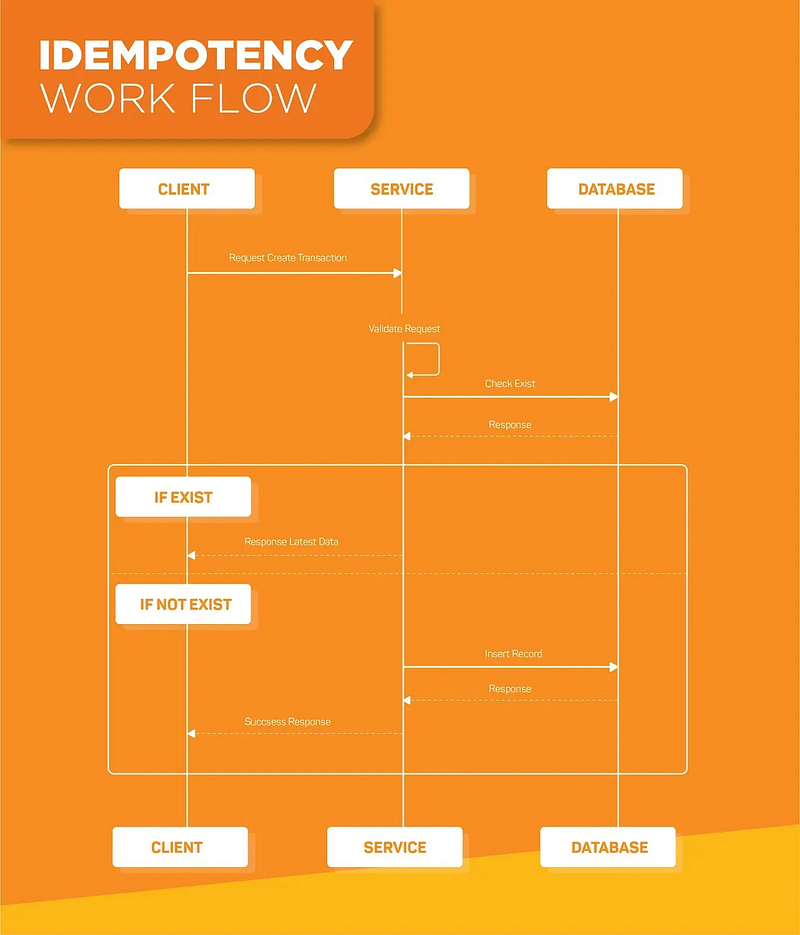
- Unique Identifier (Unique ID) can be in the form of Reference ID, Transaction ID, Inquiry ID
- Check it First then Execute the logic approach before executing the main logic, we must check it first whether the Unique ID already exists or not in the system.
- If found, we can return the current data
- If not found, we can execute the main logic (e.g. create a record)
Idempotent APIs
When designing RESTful APIs, it is essential to ensure that certain methods are idempotent. For instance:
- PUT Method: Always replace the resource state with the given data, regardless of the current state.
- DELETE Method: Ensure the resource is removed, and additional delete requests do not alter the state.
Idempotent Transactions
In transactional systems, idempotency can be achieved by:
- Using Unique Identifiers: Assign a unique identifier to each transaction to track and avoid processing the same transaction multiple times.
- State Checks: Before operating, check the current state to determine if the action is necessary.
- Idempotent Middleware: Implement middleware that intercepts and processes requests to ensure idempotency at the application level.
Challenges and Considerations
Implementing idempotency is not without challenges:
- Complex Operations: Some operations, particularly those with multiple steps or side effects, can be difficult to make idempotent.
- Performance Overhead: Ensuring idempotency may introduce additional checks and state management, impacting performance.
- State Management: Keeping track of state and unique identifiers can add complexity to the system design.
Sample Pseudo Code
func (s *OrderService) Create(payload models. Payload) (res models. response, err error) {
 // STEP 1: do some request validation here
 err := s. ValidateRequest (payload)
 if err != nil {
  return
 }

 // STEP 2: check exit on database
 checkExist, err := s. OrderRepository.GetByRefID (payload.RefID)
 if err != nil {
  return
 }

 // IF exists return the latest data
 if checkExist != nil {
  res.Data = checkExist
  return
 }

 // STEP 3: if not exist create a new one
 createOrder, err := s. OrderRepository Create (payload)
 if err l= nil {
  return
 }

 res Data = createOrder
 return
}
Conclusion
Idempotency is a vital concept in programming, ensuring that repeated operations do not lead to inconsistent states or unintended side effects. By designing idempotent systems, developers can enhance reliability, handle errors gracefully, and build scalable, robust applications. Understanding and implementing idempotency effectively is key to creating resilient software that can withstand the challenges of real-world use cases.
#idempotency #programming #golang